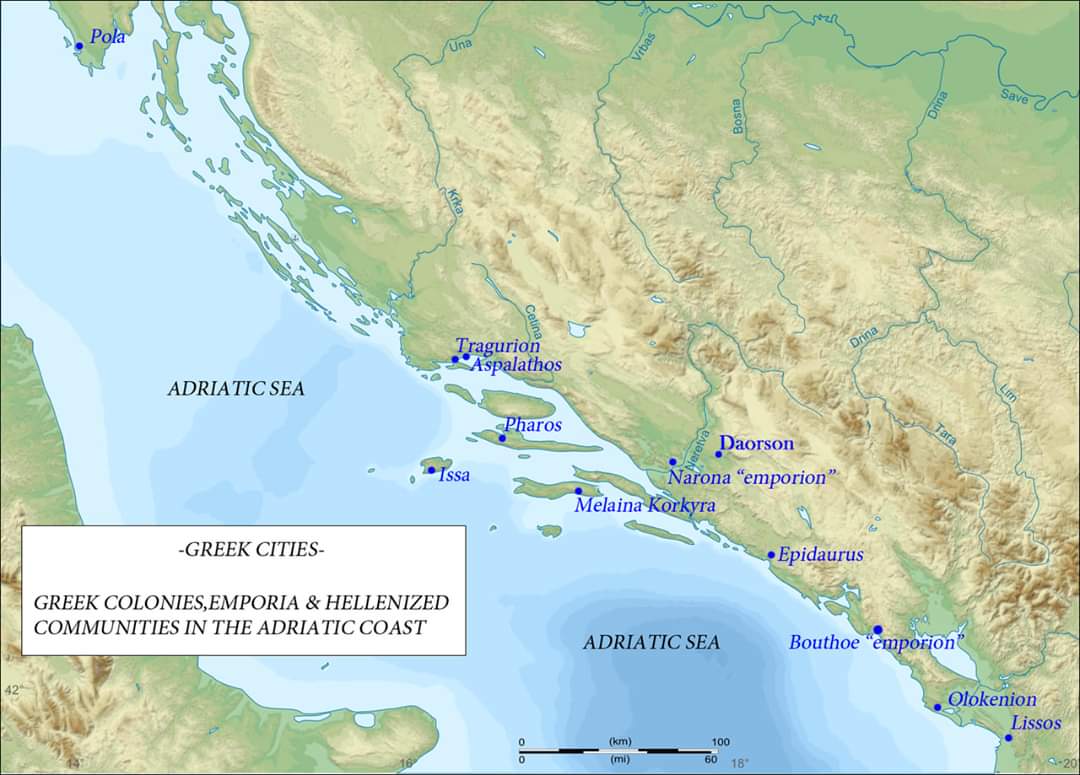
Look at a map of ancient Greek colonization, there is one area where the Greeks don’t appear to have any presence?? the Adriatic! every single one of them omits the Greek colonies of the Adriatic, possibly because these areas never grew to any great importance or status, or because they supposedly came a little later in the classical timeline. For the purpose of greater understanding we shall endeavour to shed some light on this dimly lit corner of Greek colonisation.
Greeks on the Italian Adriatic
ADRIA
Adria from which the “Adriatic” owes it’s name was founded around 520BC making use of the advantageous trading position where the Po river could gain access through lagoons by canal to the sea bringing trade into the heartland of Eturia. The first Greek colonists arrived from the city of Aegina, drawn by the lucrative trade in Amber that made it’s way down from the Baltic sea. Much later colonists from Syracuse under the direction of “tyrant” Dionysius I colonised the city making it into a trade emporion. In time the region was overun by migrating Celts who settled and intermarried, creating an interesting cosmopolitan population of Venetians, Celts, Etruscans and Greeks. Dionysius I would be one of the first to recognize the worth of the Celts in battle and recruit them as mercenaries in his armies in Sicily.
RAVENNA
Ravenna consisted of houses built on piles on a series of small islands in a marshy lagoon. Supposedly founded by a coalition of Thessalian Greeks, Etruscans and the Umbrians. Later the area was settled by marauding Celtic Senones and the Greek presence diminished until it was largely forgotten.
SPINA
Spina was founded around 525 BC, soon after Atria. It had the predominantly Etruscan population, but also a significant Greek trading emporium. The population of Spina became significantly Hellenised. Many of the goods imported through Spina were destined for the bigger Etruscan city of Felsina. The city was at the southern end of the ancient Amber road from the Baltic sea. This trade was done through the Veneti, whose cities were to the north. They also traded in horses, for which the Veneti were famous.
ANCONA
Ancona was founded by Greek settlers from Syracuse in about 387 BC, who gave it its name: Ancona stems from the Greek word ancon meaning “elbow”; the harbour to the east of the town was originally protected only by the promontory on the north, shaped like an elbow. Greek merchants established a Tyrian purple dye factory here. In Roman times it kept its own coinage with the punning device of the bent arm holding a palm branch, and the head of Aphrodite on the reverse, and continued the use of the Greek language.
Greeks on the Dalmatian coast
ISSA
Vis is an offshore island in modern Croatia, In the 4th century BC, the Greek tyrant of Syracuse, Dionysius the Elder, founded the colony Issa on the island. Later, it became an independent polis, and even minted its own money and founded its own colonies, the most notable of which was Aspálathos. Greek influence waned by the 1st century BC, the island was then held by the seagoing tribe of Liburnians famed for their unique fast vessels adopted by the Romans. Its importance in the region ended with the first Illyro-Roman war (29-219 BC). Having sided with Pompeus during the period of civil struggles in Rome, became an “oppidum civium Romanorum” in 47 BC.
PAROS
In 384 BC, the town was formally founded by ancient Greeks from the island of Paros in the Aegean Sea. They gave the name Faros to their new settlement, an independent state permitted to mint its own money. The nearby plain was marked out with roads at right angles, and divided into fields of standard size. The Stari Grad Plain today represents one of the best-preserved examples of ancient Greek agriculture throughout the Mediterranean. The settlement lay at the lower end of Stari Grad Bay, defended by two strongholds on the north and south hillsides overlooking the harbour. By 218 BC Greek presence had receded and the Illyrian tribes had moved in. The Romans defeated the Illyrian army at Pharos during the Second Illyrian War, and the town was destroyed by the Roman army, but remained under Illyrian control.
MELINA KORČULA – Black Corfu
According to legend, the island was founded by Trojan hero Antenor in the 12th century BC but it’s not until the 6th century BC that the first Greek colonists arrived from Cnidia, Greek colonists from Corcyra (Corfu) also formed a colony on the island in the 6th century B.C. The Greeks named it “Black Corfu” after their homeland and the dense pine-woods on the island. Greek artifacts, including carved marble tombstones can be found at the local Korčula town museum. A stone inscription found in Lumbarda, which is the oldest written stone monument in Croatia, records that Greek settlers from Issa (Vis) founded another colony on the island in the 3rd century BC. The two communities lived peacefully until the Illyrian Wars.
Buthoe
A legend recounts that Bouthoe was founded by the Phoenician hero Cadmus, the founder of Thebes, Greece, when exiled out of Thebes, finding a shelter in this place for him and his wife, goddess Harmonia.
Greek colonization of Adriatic began in the 4th century BC, when an Emporium was established on the site of Buthoe. Extensive archaeological evidence places Budva among the oldest urban settlements of the Adriatic coast. Substantial documentary evidence provides historical references dating back to the 5th century BC. By the 2nd century BC, the area of Budva became part of the Roman Empire.
POLA
Greek pottery and a part of a statue of Apollo have been found, attesting to the presence or influence of Greek culture. Greek tradition attributed the foundation of Polai to the Colchians, mentioned in the context of the story of Jason and Medea, who had stolen the golden fleece. The Colchians, who had chased Jason into the northern Adriatic, were unable to catch him and ended up settling in a place they called Polai, signifying “city of refuge”.
https://en.m.wikipedia.org/wiki/List_of_ancient_cities_in_Illyria

 Obscure Antiquity