—THE GREEKS IN AFRICA— PART III
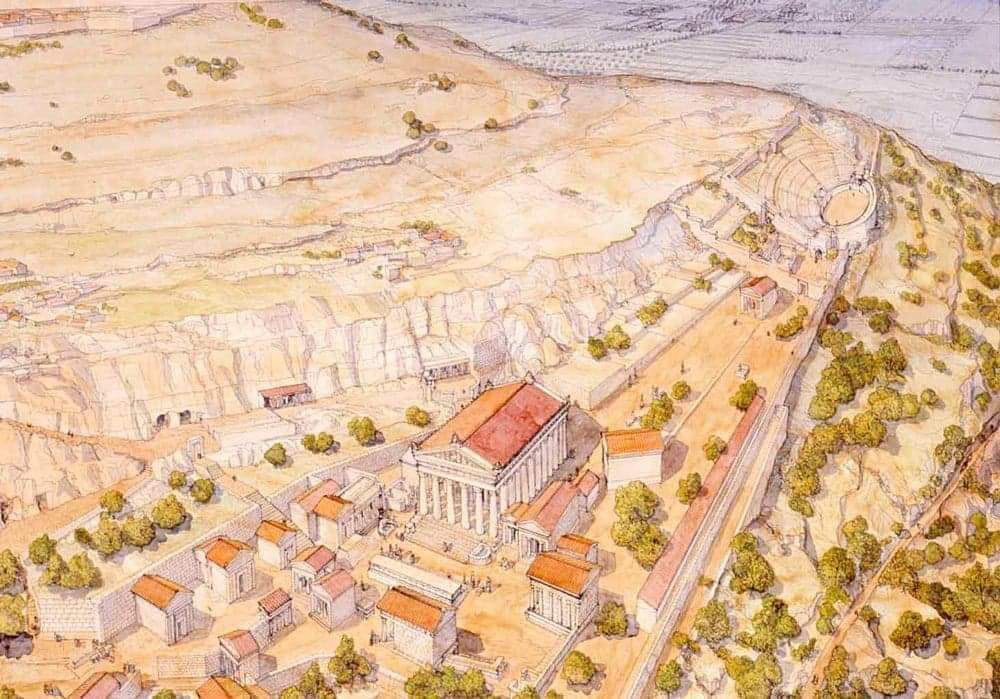
Cyrene was a Greek city in Africa famed for the production of the medicinal Silphium, a plant that was used in antiquity as an aphrodisiac. Little wonder the city grew also to be famed for the philosophy of the Cyrenaics, a school of philosophy that taught that the only intrinsic good is pleasure. Cyrene grew rich from trade and became the principal city of the western Pentapolis, a group of five Greek cities. Barca was one of these cities.
–𝑳𝒐𝒏𝒈 𝒍𝒊𝒗𝒆 𝒕𝒉𝒆 𝑲𝒊𝒏𝒈–
For a time Cyrene was ruled by King Battus the lame and his insidious wife Pheretima. After a series of losses to local Libyan tribes the royal house had lost much of it’s power and privileges but when Battus the lame died and left the crown to his son Arcesilaus, great disturbance arose about the privileges.
For Arcesilaus refused to submit to the new arrangement and claimed all the old powers of his forefathers. Revolt stirred in the agoras of Cyrene against the power of Arcesilaus. In the contention which followed Arcesilaus was worsted, whereupon he fled to the island of Samos, while his mother took refuge at Salamis in the island of Cyprus both seeking to raise forces to support their claim to the throne and restore their house to power.
In Cyprus Pheretima was received by king Evelthon of Salamis though she had little luck raising forces. Evelthon preferring to shower her with gifts rather than an army. Meanwhile at Samos, Arcesilaus was collecting troops by the promise of granting them lands. Having in this way drawn together a vast host, he sent to Delphi to consult the oracle about his restoration. He felt the answer of the Pythoness was agreeable so he set off across the sea to Cyrene, taking with him the troops which he had raised in Samos.
–𝑹𝒆𝒗𝒆𝒏𝒈𝒆 𝒊𝒔 𝒇𝒖𝒕𝒊𝒍𝒆–
In no short time Arcesilaus regained possession of the supreme power in Cyrene whereupon he took revenge against those who had driven him into banishment. Some of them fled from him and quitted the country for good; others fell into his hands and were sent to suffer death in Cyprus. After this Arcesilaus went to the city of Barca. Being married at that time to the daughter of the king of the Barcaeans, he took up his abode with him. At Barca, however, certain of the citizens, together with a number of Cyrenaean exiles, recognising him as he walked in the forum, they killed him and the king! so in this way Arcesilaus met his end and the city of Barca sealed it’s fate.
Back home in Cyrene Arcesilaus mother was left in charge of royal duties but when Pheretima heard of the murder of Acresilaus at the hands of the Barcians she feared for her life and fled this time to Egypt to plead for support from the Persians.
Arcesilaus had claims for service done to the Persians since it was by him that Cyrene was put under the Persian yoke. Pheretima therefore went straight to Egypt, and presenting herself as a suppliant before Aryandes, entreated him to avenge her wrongs. Her son, she said, had met his death on account of his being so well affected towards the Persians. Aryandes the Persian satrap of Egypt, feigned compassion for Pheretima, and granted her all the forces which there were in Egypt, both land and sea. Aryandes gave the troops orders to march with Pheretima. Such was the cause which served as a pretext for this expedition: though its real object was the Persian subjugation of all Libya!
–𝑻𝒉𝒆 𝑳𝒊𝒃𝒚𝒂𝒏 𝑬𝒙𝒑𝒆𝒅𝒊𝒕𝒊𝒐𝒏–
When the huge force of Persians arrived at Barca they set about laying siege to the town, at the same time calling upon those within the town to give up the men who had been guilty of the murder of Arcesilaus. The townspeople, however, as they had one and all taken part in the deed, refused to entertain the proposition so the Persians dug in for a long protracted siege.
The Persians beleaguered Barca for nine months, in the course of which they dug several mines from their own lines to the walls, and likewise made a number of vigorous assaults. But their mines were discovered by a man who was a worker in brass, who went with a brazen shield all round the fortress, and laid it on the ground inside the city. In other Places the shield, when he laid it down, was quite dumb; but where the ground was undermined, there the brass of the shield rang. Here, therefore, the Barcaeans countermined, and slew the Persian diggers. Such was the way in which the mines were discovered; as for the assaults, the Barcaeans beat them back.
–𝑨 𝑩𝒓𝒐𝒌𝒆𝒏 𝑷𝒓𝒐𝒎𝒊𝒔𝒆–
After great numbers had fallen on both sides the Persian generals decided the Barcaeans would never be conquered by force, so they hatched a cunning plan to trick the Barcaeans into giving up the town. The Persians dug a ditch and then covered it over with wooden planks and dirt, then they called out the Barcaeans and invited them to make terms of peace at this spot. the terms were at length agreed upon. Oaths were interchanged upon the ground over the hidden trench, and the agreement ran thus- “So long as the ground beneath our feet stands firm, the oath shall abide unchanged; the people of Barca agree to pay a fair sum to the king, and the Persians promise to cause no further trouble to the people of Barca.”
After the oath, the Barcaeans, relying upon its terms, threw open all their gates, went out themselves beyond the walls, and allowed as many of the enemy as chose to enter since they thought themselves sure that the Persians would keep their word and the war was over. The Persians quickly broke down the bridge over the trench they had dug to show that the Barcaeans had been tricked and made their way through the town gates
–𝑻𝒉𝒆 𝑾𝒓𝒂𝒕𝒉 𝒐𝒇 𝑷𝒉𝒆𝒓𝒆𝒕𝒊𝒎𝒂–
The Persians sacked Barca and gave up those most guilty of the murder of Acresilaus to his mother Pheretima. She had the men crucified and hung up all around the towns walls. Then she abused the wives of these men by cutting off their breasts and also fixing them about the town. The rest of the Barcaeans were taken captive, sent to the Persian king Darius then deported to establish a remote village in Bactria for their dwelling-place. To this village they gave the name of Barca. A century later when Alexander the Great came to Bactria it already had a thriving Greek culture spawned by the Barcaean exiles.
Not long after the cruel fate of Barca, the wicked Pheretima suffered a horrid death. Her body swarmed with worms, which ate her flesh while she was still alive in this way Pheretima met her demise.

 Obscure Antiquity