—-THE GREEKS IN AFRICA—- PART IV
During the interlude of peace between the Persian war and the beginning of the Peloponnesian war was a short period of time when Athens used it’s naval power to attack the satrapies of Persia.
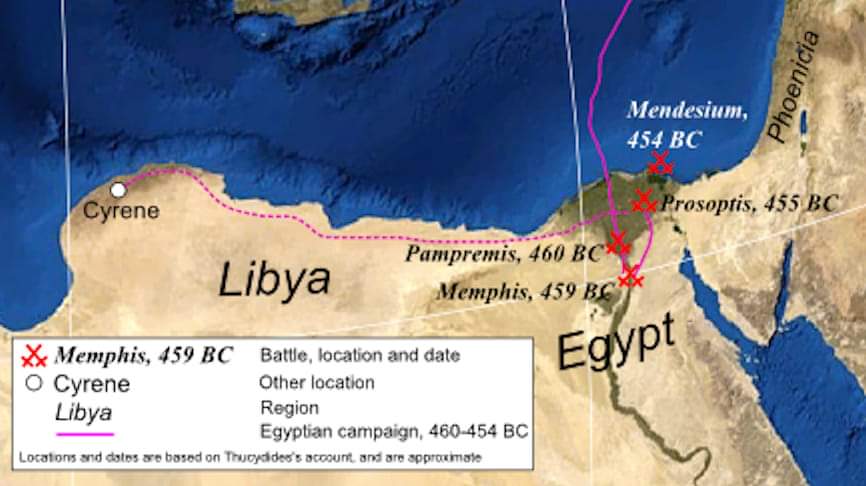
Inaros II held kingship over the Libyans and the part of the Nile Delta around Sais. Unhappy with Persian Rule he devised a plan to rid Egypt of the Persian yoke and strike Egypt into open revolt. Inaros drove out the tax-collectors and hired mercenaries, thus starting the popular revolt in Egypt. Knowing he was going to need back up against the Persian forces in Egypt Inaros called on Athens for support. The Athenians sent troops and an army of more than 200 ships led by Charitimides to aid him in 460 BC.
Inaros at the head of the revolting Egyptians and his Athenians allies confronted the Persians forces at the battle of Pampremis. The huge Persian forces initialy held the advantage through sheer strength of numbers but eventually the Athenians broke through the Persian line, whereupon the Persian army routed and fled in disarray causing great panic and loss of life. To show that their victory was complete, Inaros sent the dead body of the satrap Achaemenes to the Persian king. But the victory was not completed, more than half of the Persian force that retreated found refuge in the citadel of Memphis called the ‘White Castle’
—THE-WHITE-CASTLE—
Inaros and the Athenians thus settled down to besiege the White Castle. The siege evidently did not progress well, lasting for at least four years. In this time the Persians had the chance to devise a plan to dislodge the Athenians. At first the Persians sent bribes to the Spartans beseeching them to attack the city of Athens back home to draw off the Athenian forces from Egypt. When this failed, he instead assembled a large army and dispatched it to Egypt to quell the revolt and kill Inaros. The Persian king Artaxerxes put Megabyzus and Artabazus in charge of 300,000 men, with instructions to quell the revolt. They went first from Persia to Cilicia and gathered a fleet of 300 triremes from the Cilicians, Phoenicians and Cypriots, and spent a year training their men. It is clear that when Megabyzus finally arrived in Egypt, he was able to quickly lift the Siege of Memphis, defeating Inaros and the rebel Egyptians and Greeks in battle, and driving the Athenians from Memphis. The Athenians scrambled for their ships to make home for Athens now it seemed all was lost.
—BESIEGERS-BESIEGIED—
The Athenians now fell back to the tiny island of Prosopitis in the Nile delta, where their ships were moored. There, Megabyzus and the Persians caught up with them and now they were besieged in the island for over a year. Athens even sent a relief force in aid of the trapped Athenians on Prosopitis but before it had time to arrive the Persians devised a plan to drain the river from around the island by digging canals, thus “joining the island to the mainland”. The Persians then crossed over to the former island, and captured it. Those Athenians who surrendered were allowed to depart freely and march through the desert to Cyrene to sail home whence only a few returned to Athens. Since the defeat of the Egyptian expedition caused a genuine panic in Athens, including the relocation of the Delian treasury to Athens lest their weakness let Delos fall into the Persian grasp.
As a final disastrous coda to the expedition, the squadron of fifty triremes sent to relieve the Siege of Prosopitis also met a disastrous fate. Unaware that the Athenians had finally succumbed, the fleet put in at the mouth of the Nile, where it was promptly attacked from the land, and from the sea by the Phoenician navy. Most of the ships were destroyed, with only a handful managing to escape and return to Athens.
—HELL-HATH-NO-FURY—
Inarus was wounded in the thigh by the Persian force and retreated to Byblos. After fighting for a further year and a half in the marshes, Inaros was defeated by Megabyzus. Together with any remaining Greeks, he was taken captive away to Susa. Megabyzus promised Inaros and his rebel Greeks that they would not be executed once they arrived at Susa. The Queen wanted them punished and killed because they were responsible for the death of her son, the satrap Achaemenes, and asked for his death. The king initially kept this promise, but after five years of pleading he handed Inaros and fifty Greeks to Queen Mother Amestris.
“Inaros was executed on three stakes, fifty of the Greeks, all that she could lay hands on, were decapitated.”
Total Athenian casualties of the expedition totalled some 50,000 men and 250 ships. The revolt of Inaros, although unsuccessful in the end, left a big mark in Egyptian history. Herodotus also reports that Inaros did more damage to the Persians than any man before him.
https://en.wikipedia.org/wiki/Inaros_II
https://en.wikipedia.org/wiki/Charitimides

 Obscure Antiquity