—ANCIENT CANALS—–
The largest civil engineering project ever to be undertaken in Greece was completed by…..THE PERSIANS…????
An isthmus is a narrow stretch of land that connects a promontory stretching out into the ocean connecting two larger areas across an expanse of water by which they are otherwise separated. This geological feature can provide a defensive bottleneck for land forces or cause a lengthy obstruction that must be circumnavigated for naval forces. Oftentimes an isthmus is the chosen spot to place a canal to shorten the distance travelled by ships.
—XERXES CANAL—
During the first Persian invasion of Greece, the Persian general Mardonius spearheaded the campaign and sailed to Greece with an army of 20,000 men onboard 300 ships. Whilst attempting to circumnavigate Mount Athos his Armada was struck by a tempest and catastrophically wrecked upon the shores of Mount Athos.
When the great king Xerxes returned with his Armada during the second Persian invasion he wanted to avoid the same calamity. Three years before his arrival he commanded a canal be dug through the isthmus of Athos wide enough for two trireme to be rowed side by side. The largest civil engineering project to have ever taken place in ancient Greece and one of the only monuments the Persian host left behind in Europe. In this way the Persians made an island of Mount Athos. Herodotus reports-
“Most of the men engaged in the work made the cutting the same width at the top as it was intended to be at the bottom, with the inevitable result that the sides kept falling in, and so doubled their labor. Indeed they all made this mistake except the Phoenicians, who in this – as in all practical matters – gave a signal example of their skill. They, in the section allotted to them, took out a trench double the width prescribed for the actual finished canal, and by digging at a slope gradually contracted it as they got further down, until at the bottom their section was the same width as the rest.”
—CARIAN CANAL—
A lesser known story is the failed exploits of the Carian city of Cnidia. The Cnidians attempted to dig a canal across the isthmus of Bubassos and make an island of their land to protect themselves during the initial subjugation of the Ionian Greeks cities by the illustrious Persian general Harpagus the Besieger.
“Now while Harpagus was conquering Ionia, the Cnidians dug a trench across this little space, which is about two-thirds of a mile wide, in order that their country might be an island. So they brought it all within the entrenchment; for the frontier between the Cnidian country and the mainland is on the isthmus across which they dug. Many of them were at this work; and seeing that the workers were injured when breaking stones more often and less naturally than usual, some in other ways, but most in the eyes, the Cnidians sent envoys to Delphi to inquire what it was that opposed them. Then, as they themselves say, the priestess gave them this answer in iambic verse: “
“Do not wall or trench the isthmus: Zeus would have given you an island, if he had wanted to.”
At this answer from the priestess, the Cnidians stopped their digging, and when Harpagus came against them with his army they surrendered to him without resistance.”
—CORINTHIAN CANAL—
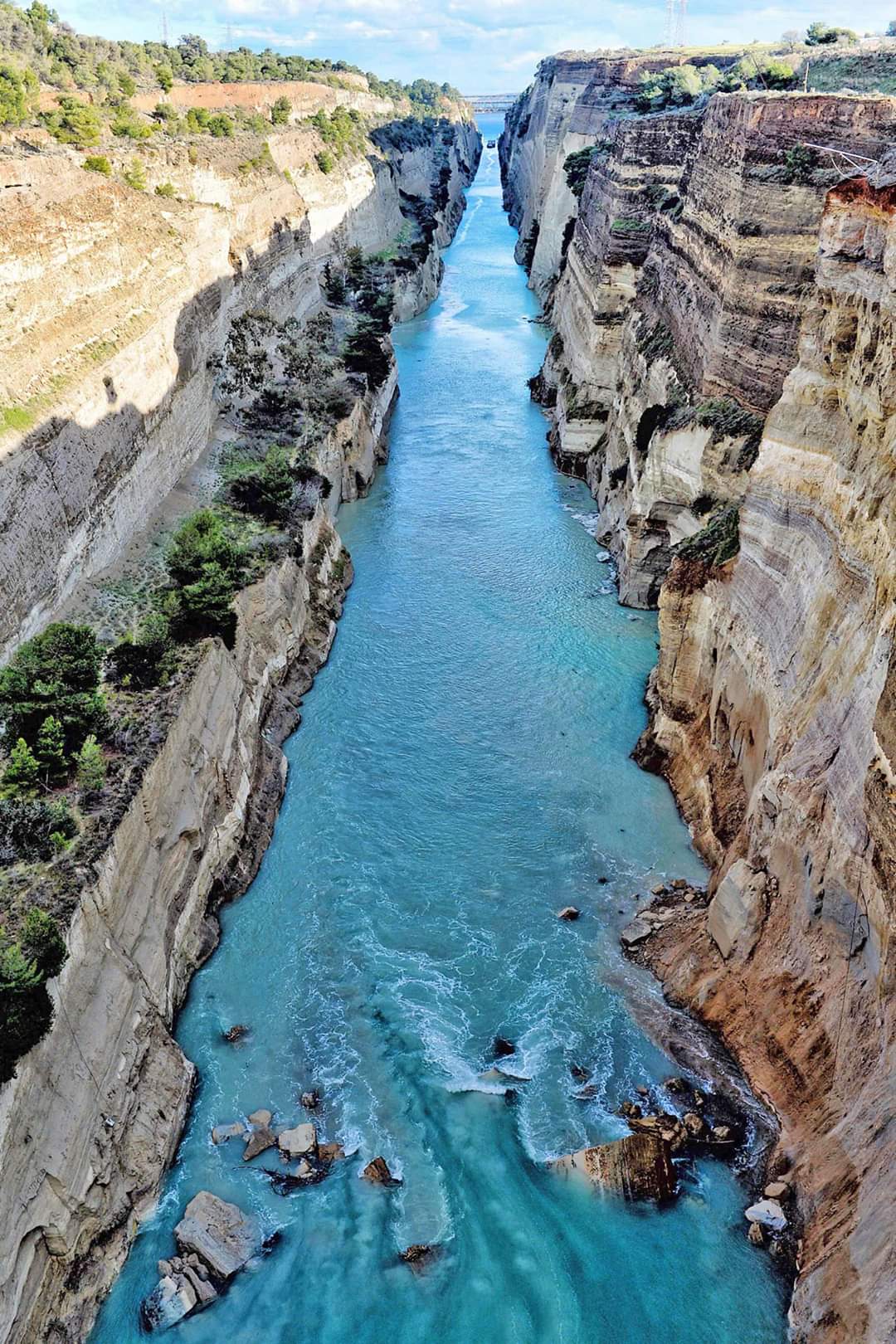
A myriad of ancient rulers dreamed of digging a cutting through the isthmus of Corinth. The first to propose such an undertaking was the tyrant Periander in the 7th century BC. The project was abandoned and Periander instead constructed a simpler and less costly overland portage road, named the Diolkos or stone carriageway, along which ships could be towed from one side of the isthmus to the other. A lack of gold and labour put an end to these early ambitions.
In the third century BC the Diadoch Demetrius Poliorcetes planned to construct a canal as a means of improving his communication lines, but dropped the plan after his surveyors, miscalculating the levels of the adjacent seas, feared heavy floods!
The philosopher Apollonius of Tyana prophesied that anyone who proposed to dig a Corinthian canal would be met with illness. Three Roman rulers considered the idea but all suffered violent deaths; the historian Suetonius writes that the Roman dictator Julius Caesar considered digging a canal through the isthmus but was assassinated before he could begin the project. Next Caligula, the second Roman Emperor, commissioned a study in 40 AD from Egyptian experts who claimed incorrectly that the Corinthian Gulf was higher than the Saronic Gulf. As a result, they concluded, if a canal were dug the island of Aegina would be inundated. Caligula’s interest in the idea got no further as he too was assassinated before making any progress.
The emperor Nero was the first to attempt to construct the canal, personally breaking the ground with a pickaxe and removing the first basket-load of soil in 67 AD, but the project was abandoned when he died shortly afterwards. The Roman workforce, consisting of 6,000 Jewish prisoners of war, started digging 40–50-metre-wide trenches from both sides, while a third group at the ridge drilled deep shafts for probing the quality of the rock. According to Suetonius, the canal was dug to a distance of four stades – approximately 700 metres – or about a tenth of the total distance across the isthmus. It wasn’t until modern times that the Greeks completed the Corinthian canal, 2500 years after it was first envisioned. At only 21 meters wide modern ships quickly outgrew the canal. It wasn’t the commercial success it’s investors had hoped.
“Sparta needs no walls”
As a short addendum to the isthmus of Corinth.
Immediately upon hearing of the defeat at Thermopylae, Sparta and her Peloponnesian allies began building a wall across the Isthmus of Corinth! The first step was to block the Scironian Way, an important road connecting Megara to Corinth. Then the wall itself was started – 3.6 miles long. Herodotus tells us the wall was mostly complete as the Battle of Salamis approached. But after the victory of the pan Hellenic forces at Marathon the wall did not need to be used.
—THE PHARONIC CANAL—
A lesser known fact is that the Suez canal of today is an ancient concept. The legendary conqueror Pharo Sesostris may have started work on an ancient canal joining the Nile with the Red Sea (1897 BC – 1839 BC), when an irrigation channel was constructed around 1850 BC that was navigable during the flood season, leading into a dry river valley east of the Nile River Delta named Wadi Tumelat. It was called the Canal of the Pharaohs. A later canal, probably incorporating a portion of the first, was constructed under the reign of Necho II around 600BC, but the only fully functional canal was engineered and completed by Darius I of Persia in 500 BC.
To celebrate this achievement, Darius erected five monuments in Wadi Tumilat, named Darius the Great’s Suez Inscriptions. The monuments contain texts written in Old Persian, Elamite, Babylonian and Egyptian, commemorating the opening of a canal between the Nile and the Bitter Lakes. The monument, also known as the Chalouf stele, records the construction of a forerunner of the modern Suez Canal by the Persians, a canal through Wadi Tumilat. The stated purpose of the canal was the creation of a shipping connection between the Nile and the Red Sea, between Egypt and Persia. The surviving inscriptions read:
“King Darius says: I am a Persian; setting out from Persia. I conquered Egypt. I ordered to dig this canal from the river that is called Nile and flows in Egypt, to the sea that begins in Persia. Therefore, when this canal had been dug as I had ordered, ships went from Egypt through this canal to Persia, as I had intended.”

 Obscure Antiquity